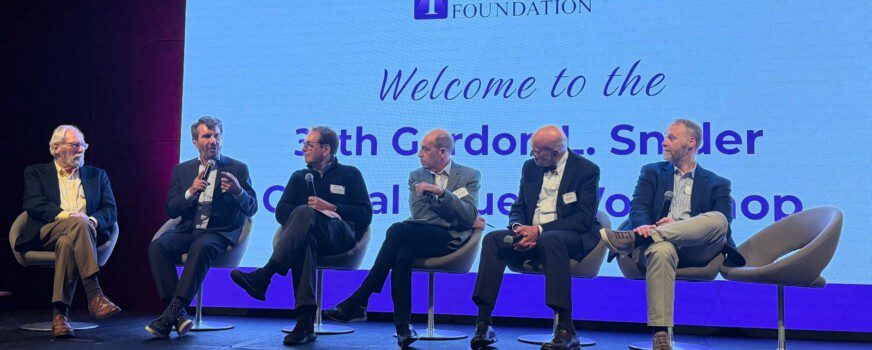
The Alpha-1 Foundation (A1F) hosted the 30th Gordon L. Snider (GLS) Critical Issues Workshop on September 10th in Barcelona, Spain. The workshop brought together researchers, healthcare professionals, patient leaders, and industry partners from around the world to discuss important questions in Alpha-1 Antitrypsin Deficiency (Alpha-1) research.
Held during the annual European Respiratory Society (ERS) meeting, this year’s workshop, “Proposing a Framework for Classifying SERPINA1/AAT Variants,” focused on finding a clearer and more consistent way to understand genetic differences associated with Alpha-1.
Alpha-1 is an inherited condition caused by changes, called variants, in the SERPINA1 gene. Not all variants affect people in the same way. Learning more about these differences can help researchers and healthcare providers better understand how Alpha-1 may affect a person’s health.
“Bringing researchers together allows us to identify opportunities, share knowledge, and strengthen collaboration across multiple disciplines to focus on the most urgent scientific questions and accelerate progress in the Alpha-1 space,” said Scott Santarella, A1F President and CEO.
The workshop was co-chaired by Andrew Wilson, MD, Scientific Director of A1F and Professor of Medicine at Boston University Chobanian & Avedisian School of Medicine, and Professor Gerry McElvaney of the Royal College of Surgeons in Ireland, University of Medicine, and Health Sciences.
The morning began with conversations about how Alpha-1 is diagnosed and how different types of genetic testing can help identify an individual’s genetic variant. The conversation then turned to why Alpha-1 can affect people in different ways, including its impact on the lungs, liver, skin, and other parts of the body. Experts also discussed how learning more about these genetic differences could support research into future treatments.
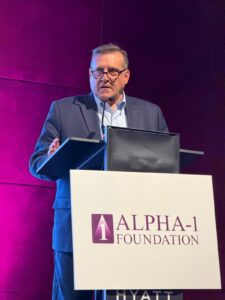
Together, these discussions led to the main question of the workshop: How can the Alpha-1 community create a clearer and more consistent way to describe and group the different SERPINA1 variants?
The patient’s perspective was also an important part of the conversation. Jon Hagstrom, Chair of the A1F Board of Directors, spoke about the importance of helping patients better understand their disease and whether they may be eligible for clinical trials.
Tomás Carroll, PhD, of RCSI University of Medicine and A1F Ireland, then presented a proposed new approach for classifying SERPINA-1 variants. The workshop concluded with an expert panel discussion, giving participants an opportunity to ask questions, exchange ideas, and consider possible next steps.
A clearer and more consistent way of classifying genetic variants could help patients and healthcare providers better understand different forms of Alpha-1. It could also give researchers a shared system to use as they continue studying the disease and potential treatments.
“A1F’s role is to build a structure that allows research to become progress, from discovery to clinical trials, from clinical trials to regulatory engagement, and from regulatory progress to, ultimately, patient access,” Santarella said in his closing remarks.
A1F gives thanks to the workshop co-chairs, presenters, panelists, and attendees who contributed their time and expertise to the day’s discussions. A special thanks to GLS workshop sponsors AlphaNet, Beam Therapeutics, CSL, Grifols, and Takeda.